
The challenge
An international fashion brand sells through its own online store, wholesale and pop-up stores, and reaches customers through many digital channels – from social media advertising to influencer partnerships and email marketing. Each of these channels has its own tool and its own data.
In fashion, collections change quickly, so you need to know fast what is selling, where and to whom. Different teams need different views of the same data:
- finance needs a monthly view of the business compared with last year and budget,
- merchandising needs collection and product performance down to individual items,
- e-commerce and marketing need traffic, orders, conversion, returns and channel impact.
The client wanted a shared data foundation that connects all sources automatically, gives every team the same validated data, and takes on new sources or new business views without a rebuild.
What we did
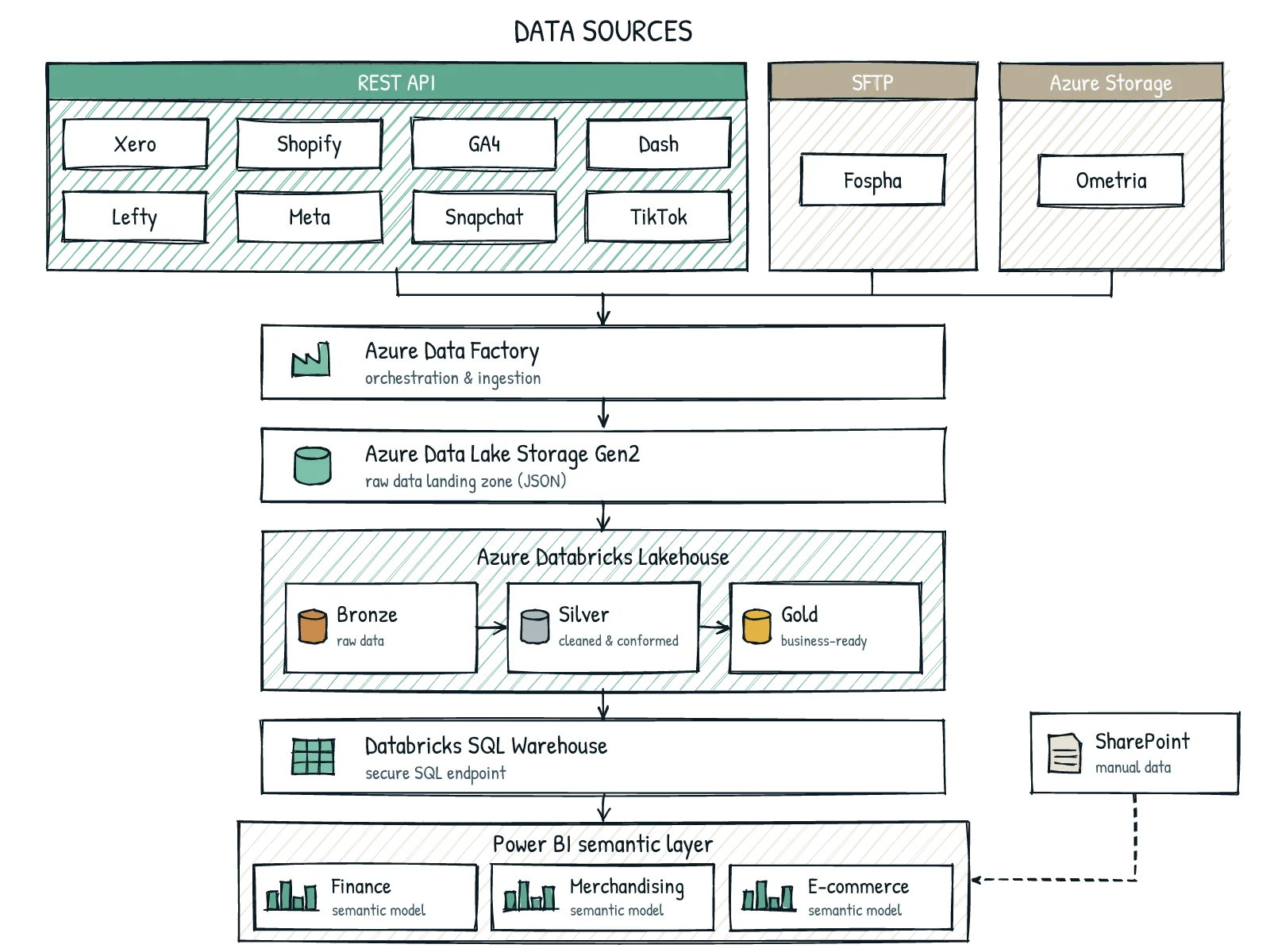
We built a layered data platform on Microsoft Azure and Databricks that takes data from raw ingestion all the way to models ready for business users.
Data sources
Azure Data Factory orchestrates ingestion from more than ten sources over three types of connection:
- REST APIs – accounting (Xero), the online store (Shopify), web analytics (Google Analytics 4), advertising platforms (Meta, TikTok, Snapchat), and the Dash and Lefty tools,
- SFTP – marketing attribution data (Fospha),
- Azure Storage – data from the customer engagement platform (Ometria).
Data platform
- Azure Data Lake Storage Gen2 – raw data lands unchanged (JSON), so it can be reprocessed at any time.
- Databricks Lakehouse in three layers – bronze holds raw data, silver holds cleaned data conformed across sources (products, channels, regions, periods), and gold holds business-ready data.
- Databricks SQL Warehouse – a secure SQL endpoint through which reports and other tools access the gold layer.
Semantic layer and reporting
In Power BI we built three semantic models on the same gold layer – for finance, merchandising and e-commerce. Data that lives in no system and is maintained manually by the teams is brought in from SharePoint under control, in one place.
Regular reporting runs on this foundation:
- a monthly finance pack – key indicators (revenue, gross margin, EBITDA) and a P&L by sales channel, compared with last year and budget, with commentary on variances,
- a weekly sales summary – growth by product line, region, category and collection, plus customer activity: visits, orders, units sold, conversion and return rate,
- bestsellers – with product images and a country filter,
- collection performance – down to individual items, with weekly sales, filters by collection, publication month and vendor, and the top products in pictures.
Why this design
Separate layers mean each step does its own job: ingestion does not mix with business rules, and business rules do not mix with reports. Because raw data is kept in its original form, a change in the rules can also be applied retroactively. The gold layer is open through the SQL endpoint – besides Power BI, other planning, analytics or AI tools can connect to it at any time.
What the client gains
- one set of numbers for everyone – finance, merchandising and e-commerce work from the same data and the same definitions,
- finance, sales and marketing in one place – sales results can be tied to channels, campaigns and attribution,
- a fast response to sales – a weekly view of collections and products down to item level,
- regular reporting from the platform instead of manual assembly from different sources,
- a platform that grows with the business – a new source means a new pipeline, not a new project; a new business view means a new semantic model on the same gold layer.
Technologies
Azure Data Factory · Azure Data Lake Storage Gen2 · Azure Databricks (Lakehouse, SQL Warehouse) · Power BI · SharePoint · REST API · SFTP