The challenge
Cast steel blocks (ingots) travel along a conveyor to the furnace, where alloying elements are added based on their chemical composition so the steel reaches the required composition and properties. Each block’s source batch and composition are retrieved through its identification marking.
The markings, however, are not standardised – from chalk-written by hand to printed plates. An operator had to read every marking and enter it into the production information system by hand. That tied the operator to a routine task, and every entry error risked the wrong alloy.
The client wanted a solution that would:
- recognise markings automatically while blocks move along the conveyor, without stopping production,
- reliably read both handwritten and printed markings,
- work in real time and locally, right next to the production process,
- pass the recognised marking to the production system for the following process steps.
What we did
We developed an automated marking recognition solution built on computer vision, machine learning and edge computing. It consists of:
- an industrial camera capturing images of the blocks and their markings as they move along the conveyor,
- a computer vision model, developed, trained and evaluated in OCI Data Science,
- an edge device beside the conveyor that runs the trained model,
- integration with the production information system, which uses the recognised marking to retrieve the batch and chemical composition.
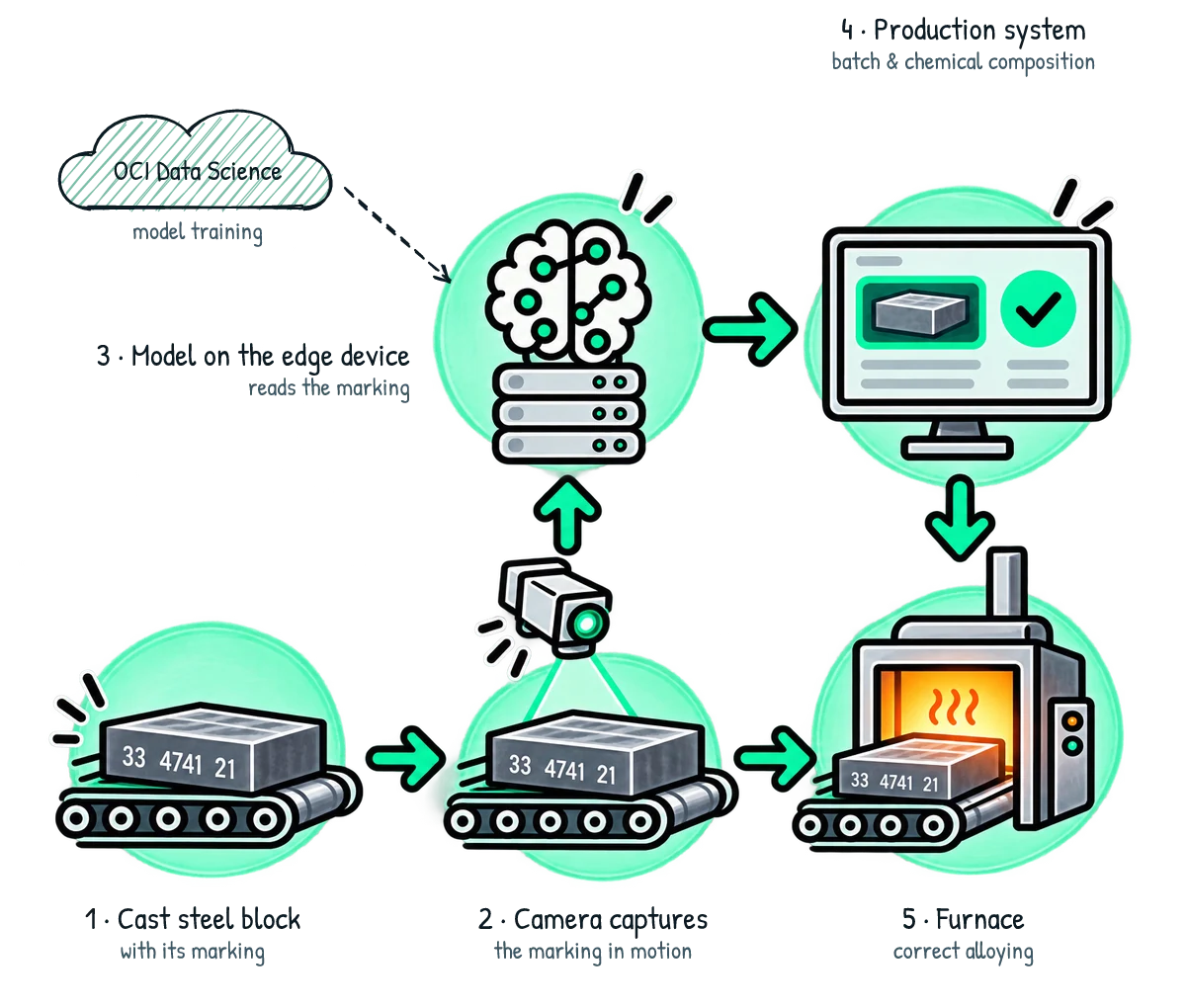
The approach is hybrid: the model is developed and trained in the cloud, where compute power is available, and runs locally beside the conveyor. Markings are read instantly, production does not depend on the cloud connection, and not every captured image has to be sent to the cloud.
What the client gains
- less manual work – operators are freed from routine reading and can focus on higher-value tasks,
- fewer errors in reading and entering markings,
- more reliable traceability – every block is linked to its batch and chemical composition,
- less risk of incorrect alloying and, with it, of an off-spec final product,
- real-time recognition that keeps working even with a weak cloud connection,
- lower costs for transferring and processing image data,
- a foundation for new computer vision use cases – visual quality control, surface defect detection and automated production monitoring.
Technologies
OCI Data Science · computer vision · machine learning · edge computing · industrial camera · integration with the production information system